The Complete P2P Trading Guide for India (2026)
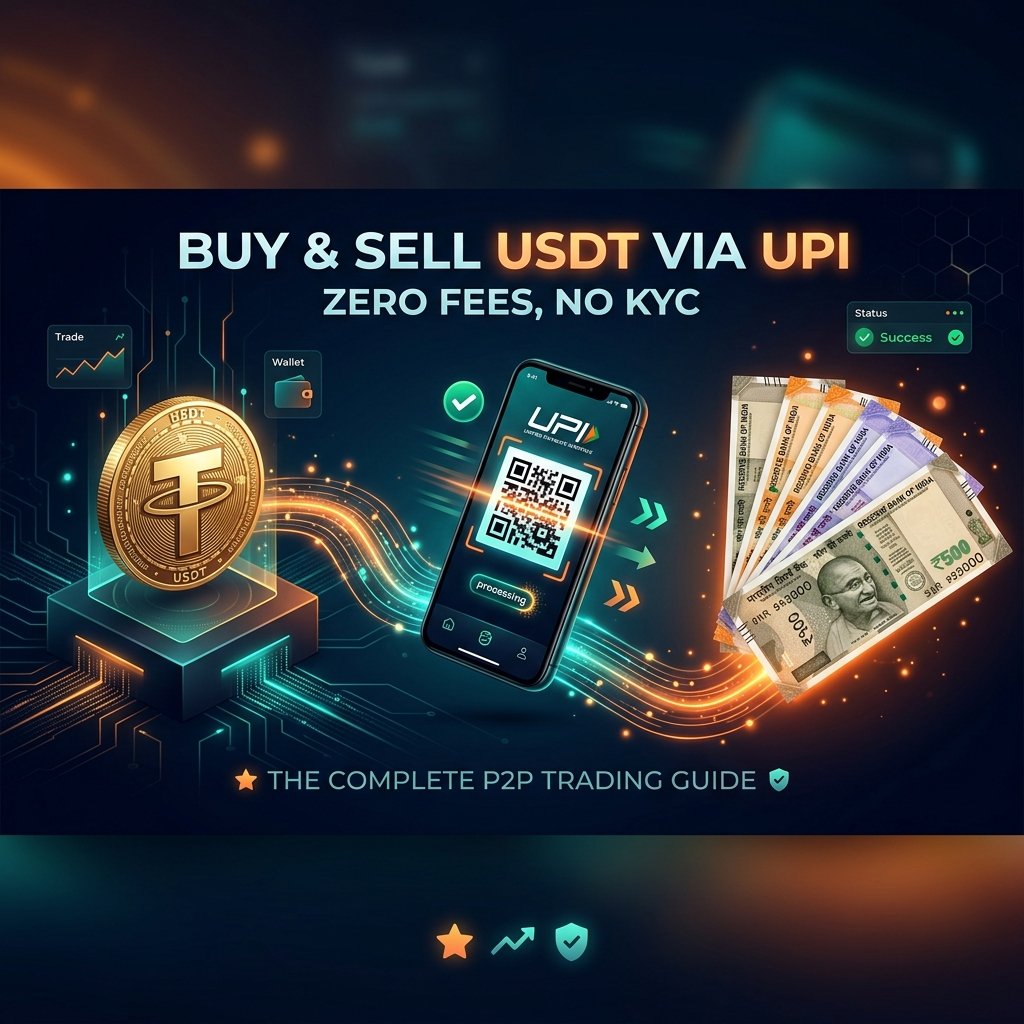
P2P (peer-to-peer) trading is now the dominant way Indians buy and sell USDT — outpacing centralized order books for one simple reason: it pays out in INR directly to your UPI or bank account. This guide walks you through everything from your first ₹500 trade to confident multi-lakh arbitrage, written specifically for the Indian regulatory and banking environment of 2026.
Skip ahead — open an account in 60 seconds
Zero trading fees · UPI Scan & Pay · Wallet-verified merchants · INR payout in minutes
Register on FastXP2P →1. What is P2P trading?
P2P trading is the buying and selling of crypto-assets directly between two people, with the exchange acting as a neutral escrow. Instead of matching at an order book, you accept a specific offer from a specific merchant. The exchange locks the seller's USDT in escrow until the buyer's INR payment is confirmed, then releases it. Risk between strangers is reduced to zero by escrow + verified identity + dispute resolution.
In India, P2P matters because RBI has historically discouraged banks from directly servicing crypto exchanges. P2P bridges that gap: you pay another Indian via UPI or NEFT, completely inside India's banking rails, and receive USDT inside the exchange.
2. How P2P actually works (under the hood)
- Merchant posts an offer — e.g., "Sell 5,000 USDT @ ₹93.40, UPI only, 5-min payment window."
- Buyer accepts — the offer's USDT is locked in escrow.
- Buyer pays via UPI — Scan & Pay the merchant's UPI QR / VPA.
- Buyer clicks "I've paid" — the timer for the merchant starts.
- Merchant releases USDT — escrow unlocks; crypto lands in buyer's wallet.
- If dispute: exchange support reviews UPI screenshots, bank statements, and chat logs.
On FastXP2P, steps 1–5 take an average of 2 minutes 11 seconds. Disputes (step 6) are escalated to a human reviewer within 30 minutes 24/7.
3. UPI Scan & Pay — the killer feature
UPI Scan & Pay is the reason P2P is so fast in India. The seller's UPI QR is shown inside the trade window; you open any UPI app (GPay, PhonePe, Paytm, BHIM), scan, type the amount, and pay. Settlement is instant (typically < 5 seconds) and the seller sees a UTR (Unique Transaction Reference) they can match.
For deep details see our Scan & Pay UPI P2P guide.
4. Create Your FastXP2P Account
Getting started on FastXP2P takes under 60 seconds — no PAN, no Aadhaar, no email, no phone, and no liveness selfie required:
- Choose your wallet type — select a 12-word or 24-word Secret Recovery Phrase wallet.
- Save your recovery phrase — write it down and store it somewhere safe. This phrase is your only login credential; there is no password reset.
- Set a username — pick a display name for the platform.
That's it. Your wallet is your account. Log in anytime using just your 12 or 24-word Secret Recovery Phrase — no email, no password, no biometrics.
5. Your first trade — a worked example
Let's buy ₹1,000 of USDT.
- Log into FastXP2P → Buy USDT.
- Filter offers: payment method UPI Scan & Pay, minimum order ₹500, merchant rating ≥ 4.7.
- Pick the lowest rate (e.g., ₹93.30 / USDT). Enter ₹1,000. Confirm.
- The merchant's QR appears with a 10-minute countdown. Open GPay → Scan → enter ₹1,000 → pay.
- Return to FastXP2P, tap I have paid.
- Within ~90 seconds the merchant releases USDT. You now have ≈ 10.72 USDT in your wallet.
That's it. There were zero trading fees. The only "cost" was the spread the merchant priced into the offer.
6. Fees, spreads & payouts
| Cost type | FastXP2P | Typical centralized exchange |
|---|---|---|
| Taker fee | 0% | 0.1% – 0.2% |
| Maker fee | 0% | 0.05% – 0.1% |
| Withdrawal fee (USDT-TRC20) | 1 USDT | 1–2 USDT |
| INR payout fee | 0 | Often hidden in spread |
| Typical spread (buy vs sell) | 0.4% – 0.9% | 0.6% – 1.5% |
The "zero fee" advertising is real, but always look at the effective rate (rate × amount) rather than the headline rate alone. Our USDT-INR calculator shows you exactly what you'll pay or receive.
7. Escrow & dispute system
Escrow is what makes P2P safe. When you accept a sell offer to buy USDT, that exact quantity of USDT is removed from the seller's available balance and held by FastXP2P. They cannot withdraw or sell it again until either: (a) the trade completes and they release it to you, or (b) the trade is canceled or auto-canceled.
If the seller refuses to release after you've paid, you open a dispute with: UPI payment screenshot (showing UTR, amount, recipient name), bank statement entry, and any chat. A FastXP2P moderator wins the dispute for you within 30 minutes if your evidence is correct.
8. Scam protection (read this twice)
Most P2P losses happen off-platform. A few rules that solve 95% of risk:
- Never trade off-platform. If a counterparty asks to "do it on Telegram" — they are a scammer. Walk away.
- Verify merchant rating ≥ 4.7 with at least 100 completed trades.
- Match the UPI account name to the merchant's verified name before paying.
- Never accept "third-party payments" when selling — only INR from the buyer's own KYC'd account.
- Save the UTR immediately after paying.
Full deep-dive: How to avoid P2P scams in 2026.
9. Taxes (India, 2026)
Every P2P trade is a Virtual Digital Asset (VDA) transaction:
- 30% flat tax on every rupee of profit (Section 115BBH).
- 1% TDS on the sell-side leg of every transaction above ₹10,000 per counterparty per FY (or ₹50,000 in the case of specified persons).
- No setoff of losses against other heads — VDA losses cannot reduce salary, business, or capital-gains income.
- Schedule VDA in ITR-2 / ITR-3 is mandatory.
For ledger templates and worked examples, see our P2P Tax Guide India 2026.
10. Advanced — arbitrage
Once you're comfortable, P2P opens up two arbitrage opportunities:
- Cross-exchange: buy USDT on FastXP2P, sell on another platform where the rate is higher. Net spreads of 0.3% – 0.8% are common.
- Cross-payment: some merchants pay a premium for IMPS while others discount UPI. Move between rails to capture 0.1% – 0.4%.
Strategies and live examples: P2P Arbitrage Strategies That Still Work in 2026.
Ready to make your first trade?
You've read enough. The fastest way to learn is to put through a ₹500 test trade. Zero fees, full escrow protection.
Open FastXP2P account →FAQ
Yes. Buying and selling USDT through P2P is legal. It is taxed under the VDA framework (30% flat + 1% TDS).
No GST applies to VDA capital transactions for retail users. GST applies only if you operate as an exchange or business with trading turnover above thresholds; consult a CA.
On FastXP2P, the practical minimum order is ₹500. There is no balance requirement to open an account.
FastXP2P earns from spread between merchant buy/sell quotes rather than taker/maker fees. Users see a transparent zero-fee experience.
UPI Scan & Pay trades typically settle in < 2 minutes. IMPS bank transfers settle within 1 hour.
No. You only need to create a wallet (12 or 24-word recovery phrase) and choose a username. No PAN, Aadhaar, phone, or email required.
It can happen if you receive funds from a counterparty whose own funds were flagged. Use only high-rated merchants (rating ≥ 4.7, ≥ 100 trades), and read our account-freeze recovery guide.
Yes. The USDT is held by the exchange — not the seller — for the duration of the trade. Disputes are resolved on evidence within 30 minutes on FastXP2P.
Open a dispute. With your UPI screenshot + UTR, FastXP2P will manually release escrow to you within 30 minutes.